Dal Church

A key’s journey through nine centuries
The stave church key that changed profession

The lock fitting was forged at the same time as the key, and similar lock fittings can be found on several old stave churches in this part of Telemark/Buskerud (Tuddal, Atrå, Numedal…). Probably forged by the same skilled blacksmith.
There is now a white church at Dal. The church was built during a reconstruction in the 18th century, as there was an older, medieval stave church here before then. And it is at the construction of this 12th-century stave church that the journey of our key fittings and keys begins. When the old Dal church was built in the 12th century, a wrought iron lock was forged and mounted on the church door.
The lock fitting is elaborate and obviously made by a highly skilled blacksmith, and it is not inconceivable that this blacksmith has made several fittings for other churches in Upper Telemark. In any case, there are several lock fittings that look very similar. Some of these still exist, while others only appear as imprints on the wood in the door. A beautiful stave church key was made to go with the lock fitting, carefully crafted by an obviously aesthetic and artistic blacksmith.
Lock fittings in two different sizes:
In the 18th century, the medieval stave church had become old and dilapidated, so much so that the entire church was rebuilt. Several of the old church’s facilities were transferred to the new church, but much was also replaced, including the church door itself. The accompanying lock and church key now embarked on the next stage of its journey. When the new church was completed in 1775, one of the neighboring farmers at Dal saw a golden opportunity: There was now a beautiful, beautiful door – with a work of art of a lock fitting – without any function! So he had the door transferred to his own farm, where it remains to this day. What for centuries was a stave church key was now used as a stave cage key at Dal Farm. A more beautiful lady of the house key could hardly be found in the whole of Telemark!

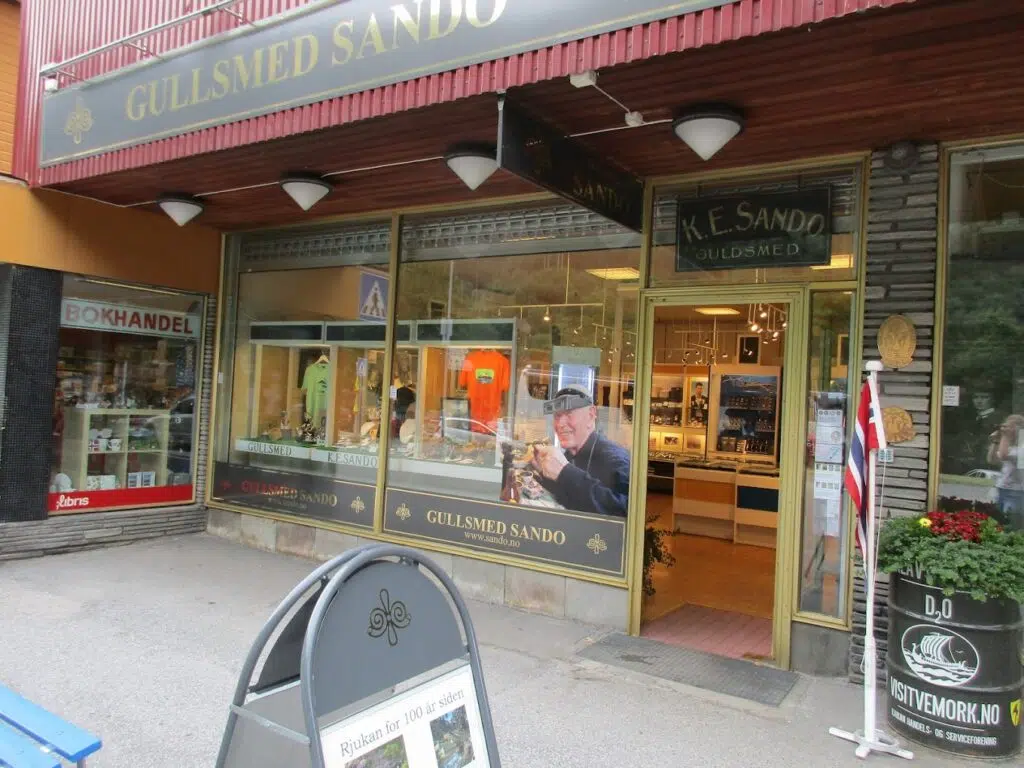
Gullsmed Sando – 4 generations of silversmith tradition.
In the 2000s 3rd generation master goldsmith Kolbjørn Sando made a beautiful silver miniature of the clasp, in two different sizes. In 2015 4th generation and current jeweler Sando, Jørgen, made a miniature in different sizes of the corresponding key. Beautiful jewelry with very local roots and a journey that unfolds over many centuries.
Although lady of the house key has nothing to do with bunad silver, we are no strangers to keys on belts. It was often the case that the lady of the house was the one who carried the keys to the storehouse, outbuildings and main house, as well as many other things. The lady of the house was responsible for food, clothing and household goods. That’s why she had a key in her belt. Being handed the housewife key by either her mother or mother-in-law was an honor, and it meant that she now had power, so it was a solemn moment in a young housewife’s life. So the symbolism of the housewife’s key, which many wear with their bunad, is precisely the woman’s power over care in the household. Therefore, many different variants of silver keys have been created to take up this tradition.
A special lady of the house key with local roots here in Tinn in Telemark is Dalenøkkelen: The key with a centuries-long journey – and a rather unusual career change.
Valley keys in different variants:
The Rose Cross
The altarpiece at Dal Church is adorned with a beautifully carved wooden rose cross, with a crucifix attached. Kolbjørn was fascinated by this rosary when he created a beautiful, solid miniature in silver. Exactly how old the rosary is is uncertain. What we can say for sure, however, is that the cross and the attached crucifix probably did not originally belong together. The crucifix probably coincided with the arrival of Catholicism in medieval Norway, and is dated to the period between 1250-1260. This dates the rosary itself to pre-Catholic or early Catholic times. The design of the rose cross itself, with carved leaves and foliage, is not a particularly Norwegian decoration, and there are several crosses with similar decorations to be found abroad. The decoration is inspired by a kind of “tree of life” symbolism and is suitable without a figure.